Wednesday, April 7, 2010

Kenya Part 1 – Lions and Cheetahs and Leopards, Oh My!

We arrived in Kenya at 7 a.m. following a 4 a.m. flight out of Mumbai, India. We had friends in Nairobi – neighbors of our camping cabin in the Methow Valley – who had arranged for a car to meet our plane and transport us to their home in a U.S. Embassy-owned house on the outskirts of the city. Candace and Bob both work for U.S. AID (Agency for International Development) and had already left for the day when we arrived, so we were let in by the housekeeper and immediately fell asleep until early afternoon. As we drove out of the airport, an accacia-dotted savanna stretched off to our left and brought tears to my eyes – it had been 25 years since I'd been in Kenya studying wildlife management for a semester in college and the view of the savanna again took me by surprise and overwhelmed me. I had finally made it back.
We spent the weekend enjoying Candace and Bob's hospitality, catching up on our cooking, and setting up our logistics for the following three weeks in Kenya. Candace and Bob also took us about 45 minutes south of Nairobi to the game ranch I lived on in college – it was a three month School for Field Studies program in Wildlife Ecology and Management, and we lived and studied on the Hopcraft Ranch, surrounded by herds of gazelles, wildebeest and giraffes on a daily basis.
It was all still there, but now as a collection of cabins for rent where our tents had been and a restaurant where our we had had our communal kitchen and classroom. It was a very cool and nostalgic feeling to be back, and we enjoyed a wildlife-filled drive around the ranch after finishing our lunch at the open air restaurant among the accacia trees.
On Monday morning, we were picked up by our driver for our next six days on safari – order of business: Masai Mara National Park, Lake Nakuru National Park, Lake Naivasha National Park and Crater Lake Wildlife Sanctuary.
We headed out of town and about an hour later arrived at the rim of the Rift Valley, pulling over to look out over the beautiful, stark scenery. We stopped again in Narok for a local lunch of ugali (similar to a sticky polenta) and beef stew, before completing the last leg of the five hour drive by heading south into the Mara along an unpaved track through fields of cattle, gazelle and zebra, before finally arriving at the park's southeastern gate.

Our camp was just outside of the gate, overlooking the small outpost at the entrance – a Maasai town of small rickety shops, cattle enclosures, and a traditional village dependent on the tourist trade. At every swing through the outpost, our jeep would be swarmed by middle-aged and elderly women selling beaded jewelery – beautiful, ornamental decoration ubiquitous among the Maasai, but a bit overwhelming when hoisted within inches of your nose by two dozen pairs of hands backed by a babble of voices quoting prices and entreaties. We waited until the last day to actually select a couple of pieces, so as not to encourage any more of a circus than the standard fare on our several passes through the gate.
When we arrived at camp, we met Garuya, our guide for the next few days, and headed out for a nature walk in the forest behind our camp.
Native Maasai and raised a two-hour walk from the camp, Garuya was a font of knowledge about local plants, animals and birds. We collected and sampled half a dozen medical herbs and found small bush buck and dik-diks in the brush as we followed the ridge above camp. We arrived back before the light faded, and enjoyed a dinner of simple Kenyan dishes served near the fire before heading to bed for the night. We were in canvas tents with two comfortable cots inside, neighbored by outhouses and open air showers. It was perfect – simple but comfy, and only minutes from the park entrance.
The next morning, we woke and ate breakfast on a leisurely schedule, leaving camp at around 9 a.m. for a full day in the park. The Mara was incredible – the smaller portion of the Maasai Mara/Serengeti National Parks of Kenya and Tanzania lie on the Kenyan side of the border, but the area is still expansive and we only covered about half the length of the park during the entire day.


In addition to the standard grazers (we saw Thompson's gazelles, impala, kongoni, dik-dik, bush buck, Grant's gazelles, waterbuck, topi and buffalo), we also found herds of elephants, giraffes, zebras, warthogs, and a couple of black rhinos. Vervet monkeys and mongoose put in appearances, and we saw hyena slinking through the tall grass.

To cap it all, and with the help of a network of cell phones and Garuya's impressive tracking skills, we found a pride of sleeping lions and a pair of cheetahs shading themselves from the sun after devouring their morning kill. And that was all just on day one!
Our day also included a lovely picnic under an accacia tree at the top of a small hill, so that we could see approaching predators, as well as park rangers, since we weren't supposed to be outside of our jeep within the park. We finally made our way back to camp at about 5 in the evening, and found a new resident, Dana from the Czech Republic, had joined our camp.
She was a PhD student in parasitology, investigating the possibility of a lifelong dream to move to Kenya, a la Joy Adamson. This was her first visit, and she was on a budget, so we invited her to join us on our game drives in the park the next day.

We had dinner and s'mores around the campfire that night, and got ourselves ready for an early morning start the following morning, so we could catch the critters that hide by day (Colin's attempt at early rising pictured).
Aside from adding a jackal to our tally and seeing hundreds of brightly colored birds (my favorite being the lilac-breasted roller), we spotted hippos and crocodiles at the river separating Kenya and Tanzania.
We also found a pride of lions on the hunt – incredible! Even more incredible was watching as the herd of buffalo they were hunting turned the tables on them, getting the lions on the run with the buffalo in pursuit! We found many more during our day of wildlife viewing – including a trio of lions which had just snacked on a porcupine and still had porcupine quills protruding from their bellies (our guide found the spot where they'd caught him and retrieved a quill with lion blood still on it as a keepsake for Colin) - and then returned to camp for lunch. On the afternoon game drive, as evening approached, the highlight of the day occurred: a brief glimpse of a leopard skirting the roadside before saying nertz to the growing number of jeeps converging on his chosen haunt and disappearing into the tall grass. We made it out of the park after sunset (and after curfew – the park was already officially closed), and collapsed into our tents happy and exhausted.

Our final morning in the Mara started with a visit to the Maasai village at the edge of the outpost, where we were greeted by young men in warrior dress, given a tour of the homes and livestock enclosures, and treated to a couple of traditional songs and fire-making demonstration before entering the crafts complex where we were obliged to visit each family's area before selecting our chosen pieces.
I selected a simple Maasai necklace as a wall hanging and Colin chose a carved wooden club, used in some of the ceremonial dances.
After one more quick tour through the park (focus of the day: rhinos), we packed up our gear, along with half the camp equipment, and headed for Lake Nakuru, via the site of the coming weekend's race car rally.
We dropped off a dozen canvas tents and some of the camp staff, because the tour company's owner is an avid rally driver and would be hosting a large party throughout the weekend races. Arriving at Lake Nakuru (with Dana, who had decided to come with us), we glimpsed a lion perched on a fallen tree before arriving at a guest house belonging to the Wildlife Club of Kenya – a lodging we found in our guidebook in lieu of camping, partly because the forecast called for rain (in buckets!) and partly because most of the camping gear was needed at the car rally. Turned out we had the guest house – and its kitchen – to ourselves, and spent a pleasant night cooking, eating, reading and sleeping to the sound of rain on the roof.
We woke to views of gazelles out of our window and headed out to circle the lake in our jeep.

We were greeted by hundreds of baboons as we set out, and enjoyed seeing nearly a dozen endangered white rhinos and the lake's famous pink flamingos in our circumnavigation.

Lake Nakuru is a small but beautiful national park, and much more easily navigable than the expansive Maasai Mara – we picnicked at a viewpoint on the lake's western cliffs and dropped Dana off in Nakuru town before heading south to Lake Navaisha.
Dana was headed to Lake Baringo to the north via matutu – the local minivan buses that are packed to the gills with locals traveling on the cheap. We planned to meet her again in Lamu, off the Kenyan coast, if our schedules meshed.
At Lake Naivasha, we were given a choice between the backpacker tents at the lakeside (Fisherman's Camp) or the simple camping cabins with beds at the top of the hill overlooking the lake (Top Camp). We opted for the cabins, mainly because we saw them first, but were later grateful for the peace and quiet that having some distance from the lake afforded us. We went down to the lakeside and had lunch at the campground restaurant, then boarded a small boat for an afternoon of hippo viewing and a visit to Elsamere, Joy Adamson's residence.
Despite our motor failing, we had a nice journey (partially towed by another boat), toured Adamson's house, enjoying her paintings, watching a documentary film about her life in Kenya raising lions and other wild cats, and having tea in her dining room before heading back to Fisherman's Camp for dinner. The down side of staying at Top Camp was being stuck when our driver didn't show on schedule – I had just talked the manager of the restaurant into driving us back when he showed up – to our relief, because our hard-sought ride had just asked me: “I hope you don't mind if Ive had a few drinks?”
The next morning, our driver once again didn't show on schedule, but this time it was daylight and we hiked downhill to the restaurant for breakfast, leaving a note and our bags behind. Just as we were considering calling the company owner at his race car rally, our driver showed up (he had a talent for nick-of-time appearances) and off we went to the highlight of the trip for me – Crater Lake Wildlife Sanctuary, where we didn't need to be in a vehicle to see the wildlife.

We hiked through the sanctuary on foot, walking through grasslands full of giraffes and gazelles, and finally seeing eland – a large, cattle-like antelope that has a reputation for extreme shyness. Nonetheless, we walked within 50 feet of one, joyous at being in such close quarters with so many animals! After a couple of hours, we continued on out of the savanna and over a ridge leading to the crater lake itself – a tiny but beautiful blue lake fringed by a handful of flamingos and colobus monkeys hollering in the trees.
An exclusive, rustic resort sits on the lakeside opposite where we crested the ridge, so we stopped for a cool drink after walking around the water's edge, and finally tore ourselves away to head back to Lake Naivasha and prepare for our return to Nairobi.
We had lunch at a local restaurant on the grounds of one of the many flower orchards bordering Naivasha (Dutch flower growers have come to dominate the local economy in the last 20 years), where Colin played pool with our driver, beating him and winning himself a coke in the deal. Then it was back on the road to Nairobi, arriving back at Candace and Bob's in the late afternoon, and settling in to wait for them to arrive home from work. We had one more night with them before catching a plane the next day to Malindi, on the coast, where we were to volunteer at an orphanage for the coming week. We all went out to dinner that night with friends of theirs at an upscale Asian restaurant in an exclusive gated community, sharing sushi and curries and grilled fish around the table. Delish. But....
I woke up at 4 in the morning sick as a dog – retching and dizzy and as food-poisoned as I've ever been. I don't know if it was the lunch or the dinner, but I was the only one to get sick (thank goodness!). I couldn't even get out of bed and away from the bathroom long enough to go see a doctor, let alone get on a plane. We had to delay our departure to Malindi, making our apologies to the volunteer service coordinator who had made our arrangements with the orphanage. Candace helped to reschedule our flights, and Colin took care of both himself and me for the next two days while I slept and recovered. When I was finally able to think straight again, I discovered that our flight had had to be delayed by a full four days, because of the limited availability of seats.

So we made a few more plans for sightseeing in Nairobi, taking in the National Museum and visiting the Giraffe Center, where endangered Rothschild's giraffes are bred for reintroduction to the wild, and the Elephant Orphanage, where young elephants orphaned by poachers are raised and reintroduced into National Parks throughout Kenya. Colin “adopted” an elephant, and earned himself the right to visit in the evening when the babies are being put to bed for the night. Unfortunately, we didn't get the opportunity to return for that visit, as we finally had tickets out to the coast that afternoon, and were eager to get started on our belated stay at Malindi's Heart Children's Home....

Up Next: Mama Lucy & Mohammad's Birthday

Wednesday, March 24, 2010

India Part 2 - Backwaters and Hill Stations

Leaving the coastal backwaters of Kerala with a car and driver, Kelly, Lex, Colin and I traveled the three hours by road up into the Western Ghats – a ridge of mountains paralleling the southern Indian coast.
We arrived at the gates of the Thattakad Bird Sanctuary and were met by Sudha, our hostess, who led us – to our surprise – through the gates and into the sanctuary itself to her home – a beautifully painted two story house with four guest rooms. We were served “tea” - a spread of heaping dishes served with chapati and fruit – by the four generations of women who made up the family, and had about an hour to collect ourselves before heading off on a bird walk with Sudha. Despite already being in the sanctuary, we had to walk the opposite direction – back out of the gate – for our walk because elephants were a short distance up the road and walking in that direction would not be safe (this is the first time we heard the phrase “big problem” to refer to elephants ahead – we would hear it again and again over the coming days – Indians take the threat of marauding elephants very seriously).
The walk circled a lovely lake with a temple on one side - the evening's temple events were beginning as we finished our walk, sending the sound of bells and drums over the water and surrounding forest.
In the morning, we rejoined our car and driver for the road trip back to the coast, where we would catch our train to Calicut. Mid-way, we stopped at the Malayattor Elephant Camp, where elephants are trained from a young age for work in the temples and fields.
The elephants are walked to the neighboring river each morning, where for a tip/bribe (“baksheesh”) you can wade in and help bathe them alongside their mahout (handler). The kids had a blast helping to scrub the babies (still large enough to crush a couple of 11 year-olds in a single squat) and the image of elephants bathing and dancing (really!) in the river will be one of my lasting impressions of our entire trip – magnificent.
After a traditional breakfast at a local B&B, we continued to the coast our driver dropped us at the train station for our connection to Calicut, where we settled into a cheap (read: slightly dodgey) hotel and sought out information on transportation to our next destination – a homestay near the Mananthavady Hill Station back up in the mountains. The following morning, we headed up with another car and driver, arriving at Varnum Homestay – my favorite of all our lodgings in India - in the early afternoon.

The Varnum family – mom, dad, daughter, grandmother, and one college-age son who arrived home for a visit on our last day – lived in a traditional Keralan-style house, served meals on the outdoor terrace, and seemed completely unperturbed by all manner of foreign eccentricities (including the hard-drinking, bald Mongolian woman who wore colorful bustiers and sheer fabrics and arrived with an Italian boyfriend she had met just days earlier – we loved her!). They were warm and welcoming, easily voiced their opinions on social and political matters, and had an extensive network of relatives that were able to provide us with just about any service we required. Their home neighbored a rice-paddy frequented by elephants (“big problem”) and was in close proximity to wildlife sanctuaries and scenic mountains and waterfalls. We spent the next four days taking in some of each, and getting so relaxed it was hard to leave both the place and the Varnum family.

Day one nearly trapped us in the pleasant lull of hanging around the courtyard nibbling on the kitchen's ever-emerging snacks and watching the kids play badmitton, but we finally pulled ourselves away to walk to the nearby road and take the bus to the local town to shop for food (the kitchen was open to guests to use as they please, and Colin was determined to make use of it). After some browsing, we found something reasonably similar to pasta, plus butter, garlic and tomatoes, then headed back to the Varnum's to wait for our afternoon game drive to nearby Tholpetty Wildlife Sanctuary.

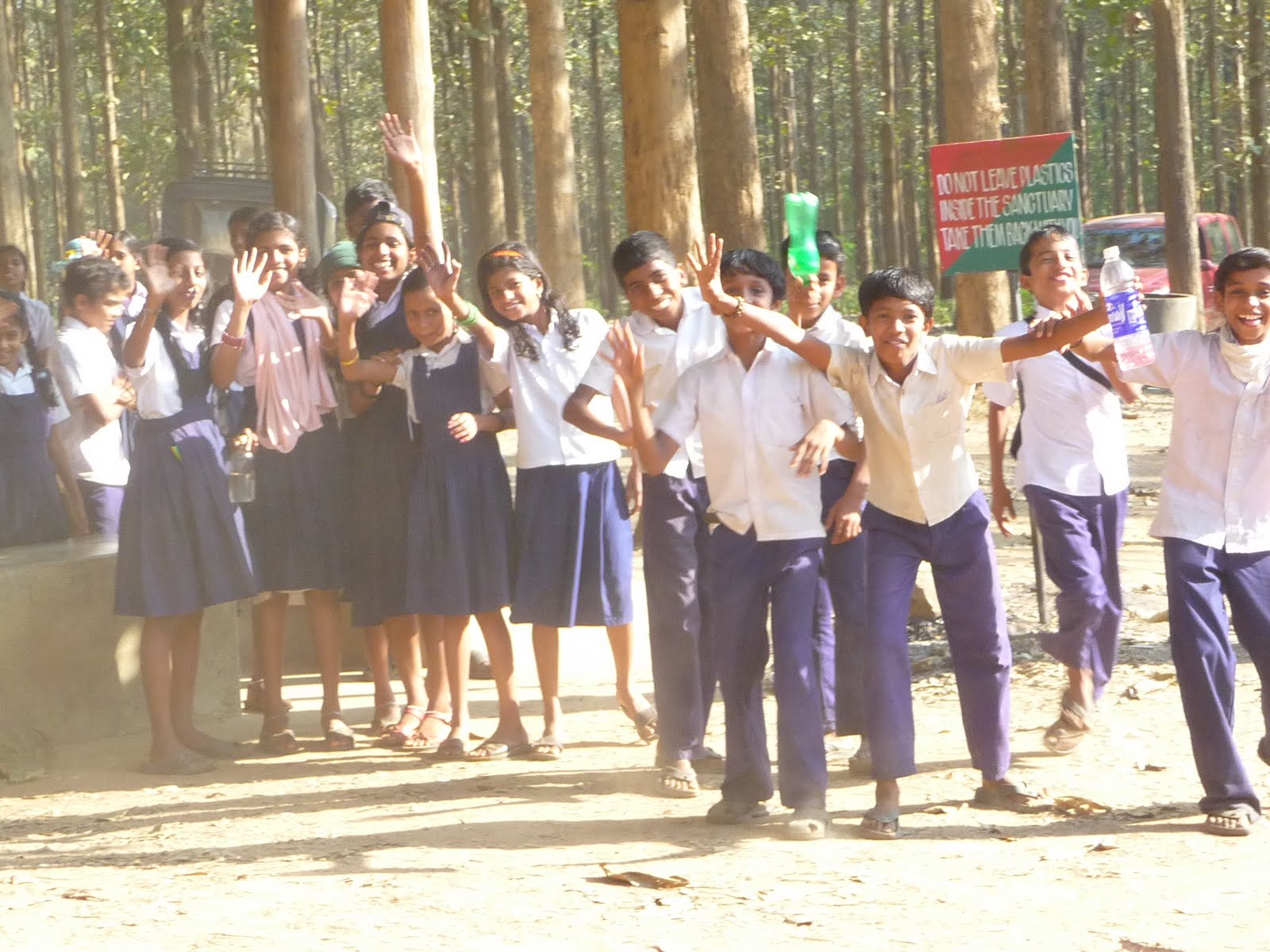
The two-hour game drive turned up dozens of sambar (a large Indian antelope), deer, wild boar, an abudance of birds, and a lot of enthusiastic school children, but the “big problems” managed to elude us – until after we left. Our driver, not wanting us to be disappointed, drove us to an area just outside of the local town, where he knew elephants often foraged in the early evening. Sure enough, as we rounded a bend in the road he slammed on the brakes and pointed into the foliage at the edge of the forest. After a moment of peering into the brush, we saw a movement of white tusks, and then the rest of the outline of the elephant emerged. It was our first sighting of elephants in the wild. We saw four more elephants, also foraging within sight of the road, before finally heading back. We ate the Varnum's amazing dinner, and slept incredibly well that night.
On day two we rose early and headed to a nearby trailhead for a 14 km roundtrip trek to the bat caves at the top of a mountain. Early into the hike, Colin complained of heat and became so uncomfortable, I didn't think he was going to make it. At about 3 km, our guide convinced him to go just a bit further to a fire lookout tower at the midway point of the ascent where he could rest in the shade.
The view was incredible! We watched birds swooping from our vantage point at the top, and were able to see a herd of buffalo cresting a ridge in the distance. After a bit of a rest, Colin decided that he was up for the rest of the trek, and we headed off again. At the top, we scrambled into a cluster of boulders and stepped over a couple of deep crevices to find a spot to cool off and have lunch – some bananas and a thick rice-flour based porridge that you broke off pieces of and rolled up in your hand to eat.
As we headed through the rest of the rocks to get to the bat caves we came to one wide crevice that brought on a bout of vertigo for me, and I couldn't cross it. The rest of the group went ahead and I turned around and waited on the trail just beyond the rocks.
It was a beautiful solo, quiet half hour of looking over the high ridges, watching birds and butterflies, and listening very, very carefully for anything rustling in the brush – we had passed tiger scat on the trail on the way up, and that was the closest I wanted to get to any big cats while sitting up there alone. When Kelly and the boys returned, they too had headed back after the boys decided the final rock climbing ascent to the cave entrance was too much, and Lex had nearly fallen into the crevice that defeated me (its apparently not supposed to be crossed from the opposite direction – the guide had planned on a different return route after visiting the caves). Despite none of us seeing the bats that had been our destination, it was a wonderful hike, and we all descended happy and satisfied – except for a pesky blister that Lex had developed on the way up – ouch! Each and every stream crossing going down was an excuse for the boys to dunk their heads in the frigid water, fill their hats, and walk on in the heat of the day with alpine water streaming down their faces. Nice.
When we returned to the Varnum house that afternoon, the Mongolian and her Italian consort had arrived.

They joined us the next day for our last field trip – a beautiful waterfall a short 15 minute walk through the forest. Kelly and I lolled on the rocks by the water, the boys braved the frigid temperatures and climbed the rocks at the base of the waterfall, and the Mongolian and Italian did it all – climbed to the top of the falls with our guide, splashed in the pools with the boys, and posed for photos along the base of the falls. Heading back to the Varnum's, we stopped in Mananthavady in search of ingredients for cooking again (unsuccessfully) and booze – our driver sent Kelly and I into a hotel in search of a bottle of wine, where we were bounced from bar to restaurant to dark, dingy hovel, only to come up empty handed. The Mongolian and Italian were looking for something stronger, so we finally convinced the driver to take us to the local “government shop” - half an hour and a lot of haggling later, everyone returned to the jeep satisfied with their acquisitions. I believe that half of Mananthavady talked about the strange group of westerners at the booze shop for weeks afterwards – Kelly was a woman alone with two children (I had stayed with the bags in the jeep); the Mongolian was a bald woman dressed in a short, sheer dress over a very visible bikini; and the Italian was a tall, gangly guy who talked loudly and smiled at everything and must have been variably interpreted as their mutual consort or pimp.
That last night, the Varnums all joined us for dinner, talking about local norms and the plans they would eventually make for their son's and daughter's arranged marriages. While strange from our perspective, it was wonderful to have a conversation about the local traditions so openly and easily with someone who was comfortable with foreigners but could also explain and defend the local traditions with ease and confidence.
Their son would be coming home from college for a visit the next morning, giving us a chance to meet him before we left – he was extremely charming and fantastic with the boys. We were so sad to leave the Varnums, and the mountains, but had a date with the beaches of Goa starting the next day, and a long way to go to get there.....
In the early afternoon, we climbed into a Varnum cousin's car and headed down, down, down to the coast. Arriving in Kannur, we had a few of hours to kill before catching our train, so we checked our luggage into the bag room at the station and asked our driver to drop off at the beach, just in time for sunset.
The rest of Kannur seemed to have the same idea, and the beach was a festive gathering of families enjoying the cooling air that came with the end of the day. They also enjoyed us – we were swarmed first by children and then by whole families interested in where we were from and why we were there. We even received an invitation to stay with one of the families at their home that evening! If we hadn't already bought our train tickets, I think we would have happily taken them up on it.
After sunset, we had a long hike out of the beach area, crossed a very busy street (dodging rickshaws in the effort) and ate dinner at a hotel restaurant before returning to the train station. We boarded our 3AC (triple decker, air conditioned) car, had an on-again/off-again night of semi-sleep as the train chugged north up the coast, and arrived in Goa the next day.
For a few days before our arrival, Colin had been having some listening problems, so we needed a day on our own to stabilize and talk things through. Kelly and Lex headed straight to the guest house she had booked for us on Agonda Beach, while Colin and I went to Palolem Beach for the day to spend some mom-and-son time.
To make a long story short, Palolem Beach was beautiful and we began to think maybe we should spend a night, while Kelly discovered that our booked guest house had given away our rooms and went looking for something new. We wound up spending the next three days each at our beach of arrival, and reunited on the last day for the continued journey to Mumbai. Once again, I think the break did the kids some good – they had been on-again/off-again bickering in the mountains, and we all had three calm days to relax and recoup before taking on the big city.


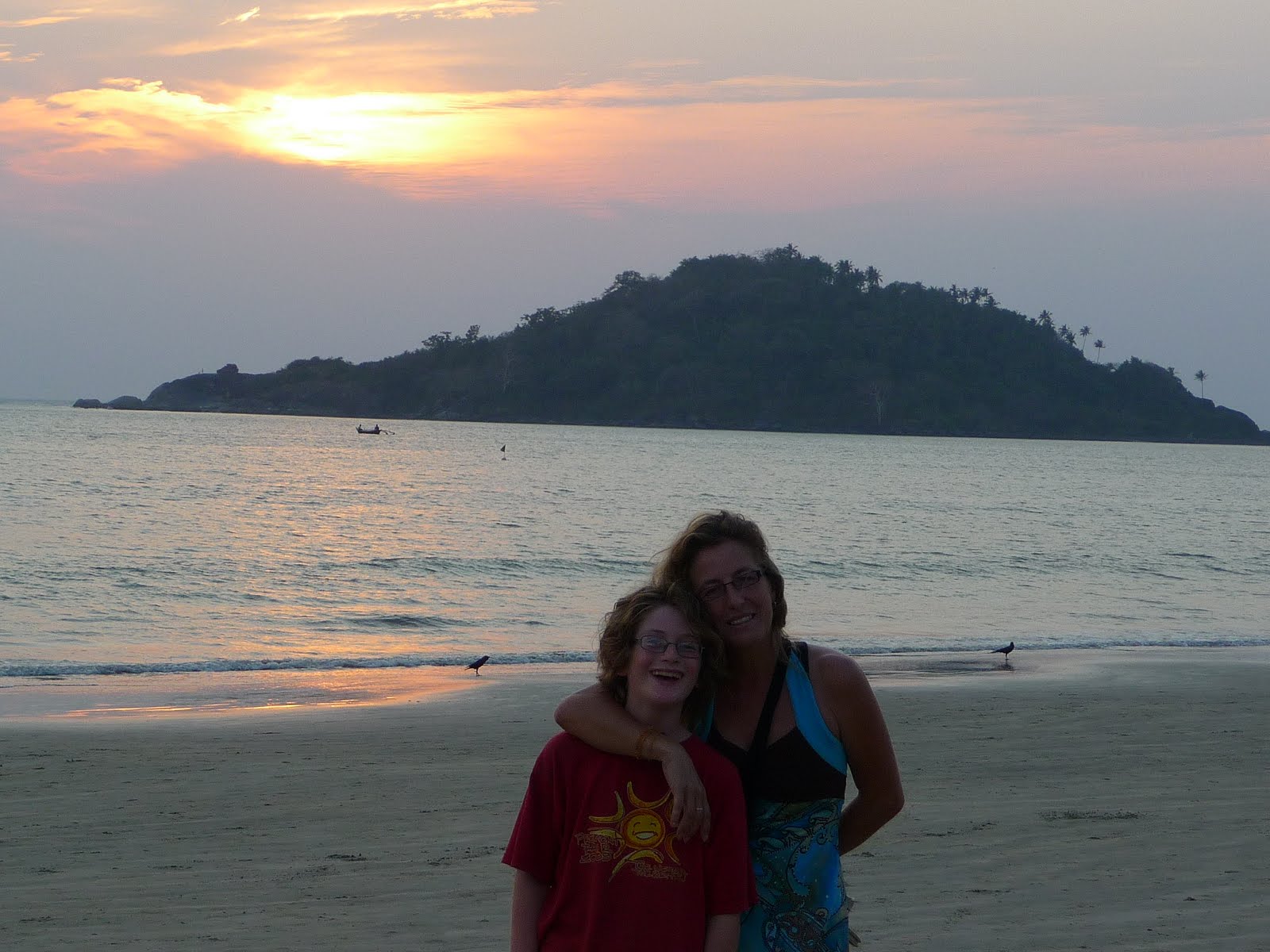
Palolem Beach was a gorgeous talcum-sandy beach, with clusters of rocks at one end and Palolem Island at the other, forming a calm crescent cove. The water was shallow and bathtub warm, and the beach was lined with thatched-roof “bandas” for rent and open air restaurants with hammocks and beach chairs for lounging over a drink or snack.
We did absolutely nothing other than to lounge and swim on our first day, taking in a nice dinner on the beach, where Colin fell asleep in the hammock while waiting for the food to arrive!


The second day we explored the beach and small town a little more, browsing in the stone and gem shops (Colin's favorite), and enjoying the sight of fully dressed women playing in the surf and cows lounging on the beach - sacred cows can go anywhere they want, and why wouldn't they want to be sunning themselves on the beach? In the evening, we found a cafe at the far south end of the beach that was showing Avatar against a broad whitewashed wall, and enjoyed local fish curry as we watched the movie. Except for an extremely hard soccer ball kicked straight into my thigh in the late afternoon, it was the perfect relaxing day. (It was also Valentine's Day, and I had managed to arrange for a bouquet of flowers to be delivered to Tom at home – an evening skype call home confirmed that they had arrived – yay!)


On our last full day at Palolem, we repeated the lulling pattern of swimming in the morning and hiding from the sun with a good book in the afternoon, then we walked to the north end of the beach at sunset and found a small boat to take us up the Palolem “River” for a bird watching trip. It turned out to be perhaps the best birdwatching hour of my life – kingfishers and brightly colored songbirds and herons, etc. Lovely! And a perfect end to our stay.
After a lazy morning the next day, we caught a rickshaw to Agonda Beach to meet Kelly and Lex, lunched at a very yummy Italian restaurant and continued on to Goa for our overnight train to Mumbai. This time we traveled in 2AC (only 2 bunks high, rather than 3) and slept for most of our journey north.

We arrived in Mumbai early the next morning, caught a taxi to the Salvation Army-run hostel we had booked in advance, and waited to check in while the staff conducted their morning prayers in the communal breakfast room. The rush on rooms at check in time (9 a.m.) was intense – we selected a four bed room with a private bath, to the ire of another prospective guest who insisted he had been in two hours earlier and had claimed that room for himself (having booked a few days in advance and by virtue of having children with us, our claim trumped his. In the end, we abandoned the room late in the evening, because while we were out sightseeing during the day, the staff sprayed the room opposite ours for bedbugs and were exceedingly overzealous with the insecticide – the entire floor reeked of pesticides late into the evening, and permeated every room on the floor. Finding it unabated after dinner, we jumped ship for a business hotel across the street at twice the price, but with the peace of mind that comes from knowing you are not being poisoned while you sleep).


Having an early start to our one full day in Mumbai, we walked around the Taj Mahal Hotel directly across the street and boarded a boat for Elephant Island at the port ferry dock. On the island, we explored the massive cave temples and enjoyed watching the island's monkeys threaten unknowing tourists who were bold or foolish enough to wander around with open bags of chips and fruit.

The temples were impressive – carved into solid stone over several generations, they included 10-meter high columns and likenesses of various Indian gods and goddesses. At one time, there had been a 30-foot tall stone elephant – the island's namesake - standing guard at the entrance, but it was damaged in a rockslide that permanently closed the temple's main entrance and was later restored and moved to the entrance of the Mumbai zoo.
We hoped to take in a Bollywood film at a local movie theater that afternoon, but none of the films showing in Mumbai had English subtitles, and we would have been completely lost seeing them in the original Hindi, so we wandered the sidestreets and stumbled onto a fantastic little pastry/coffee shop just blocks from our hostel – a fair exchange for missing the opportunity to see Bollywood in India. We finished the day with a tour through the lobby of the Taj and a nice dinner of grilled meats and veggies, before doing the hotel shuffle and drifting off to sleep.


We arranged for a car to pick us up in the morning and run us to one of the city's large indoor bazaars and the Ghandi Museum before dropping Kelly and Lex at the train station and heading for the airport ourselves to wait for our flight to Nairobi. The Ghandi Museum was a highlight of the visit to Mumbai – it was housed in the house he lived in when in the city, and gave a thorough history of his own personal history and political development, as well as the process of decolonization from England.
As for our hours-long wait at the Mumbai Airport, suffice to say that it was – hands down – the worst airport experience of our trip. If you ever must pass through there, minimize your time and maximize your patience, and make sure you've got ample rupees in your pocket to pay for the privilege....

Up Next: Kenya – Lions and Cheetahs and Leopards, Oh My!